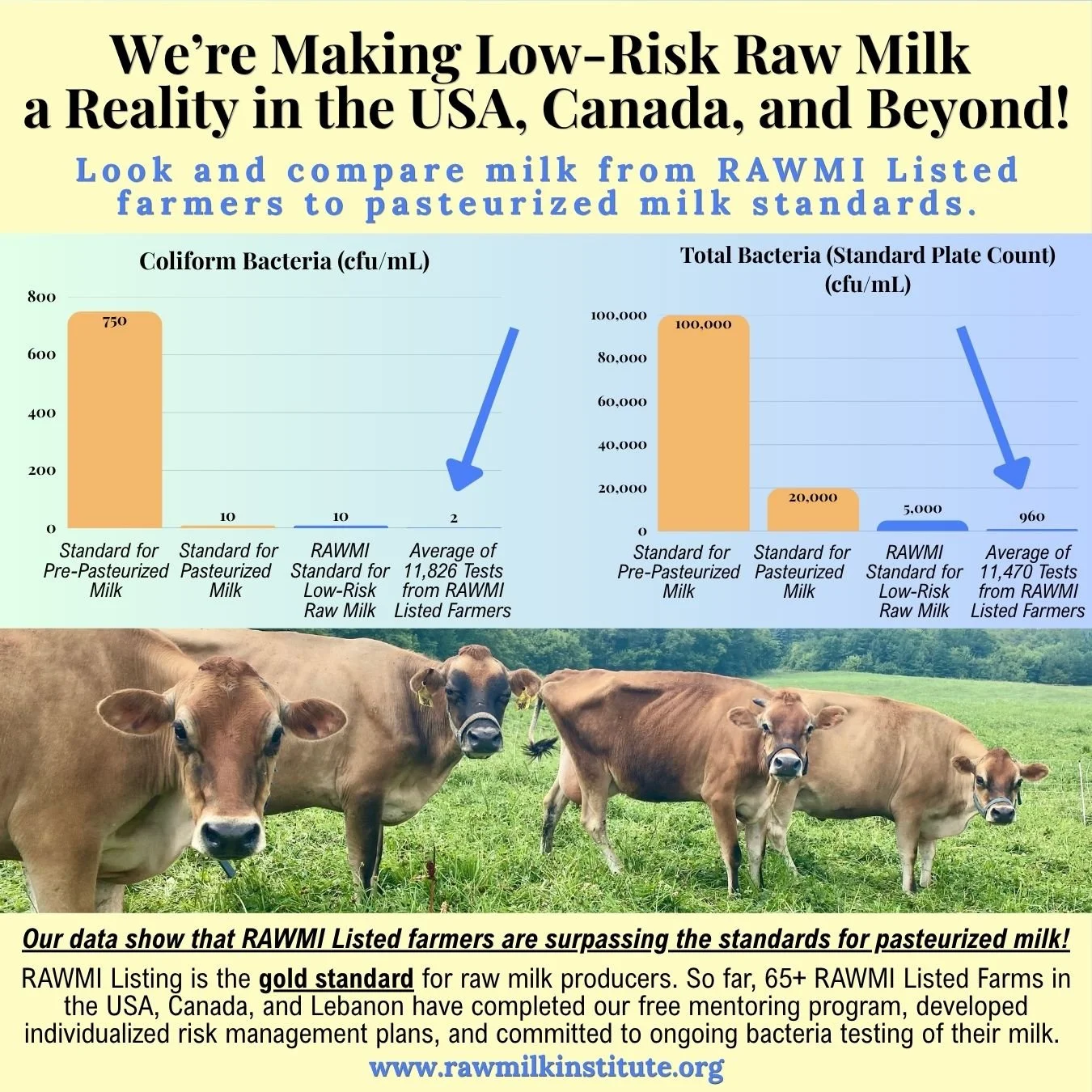
We’ve recently analyzed our database of over 11,000+ sets of coliform and standard plate count data and the results are in: RAWMI Listed farmers are surpassing the bacteria standards for pasteurized milk!
Our Raw Milk Test Database
Every month, we receive raw milk test data from dozens of Raw Milk Institute (RAWMI) Listed farmers. In order to become Listed, these farmers have completed our free intensive mentoring program, developed individualized Risk Analysis Management Plans for their farms, and committed to ongoing bacterial testing of their milk. To date, over 65+ farms have completed our Listing program.
Listed farmers are required to test their milk at least once per month for coliforms and Standard Plate Count (SPC). Many Listed farmers choose to test their milk more often, such as once per week or even daily. As a result, we collect hundreds of raw milk test data points every month from our Listed farmers and have compiled a huge test database over the last 14 years. We have now amassed over 11,000 test data points each for coliforms and SPC tests in raw milk.
About Coliform and Standard Plate Count Tests
The SPC is a measure of the total number of aerobic bacteria in the milk. High SPC numbers can indicate dirty milking equipment, poor milk chilling, udder inflammation, and/or poor udder preparation.
Coliform count measures the amount of coliform bacteria present in the milk. Coliform counts measure the overall hygiene and cleanliness of the milk. High coliform counts generally indicate the presence of manure or other environmental contaminants on the udders or milking equipment. They can also indicate the presence of udder inflammation. High coliform counts are likely to correspond to the presence of harmful pathogens in the milk.
Although these two tests do not directly detect the presence of pathogens, they serve as general indicators that the milk is being produced hygienically and in such a way that pathogens are less likely to be present. No food can ever be perfectly safe, but nonetheless these tests can help to dramatically decrease the risk of having pathogens present.

Standards for Pasteurized vs Raw Milk
Below is a summary of the coliform and SPC standards for raw, pre-pasteurized, and pasteurized milks, in units of colony-forming units per milliliter (cfu/mL).
Standard Plate Count
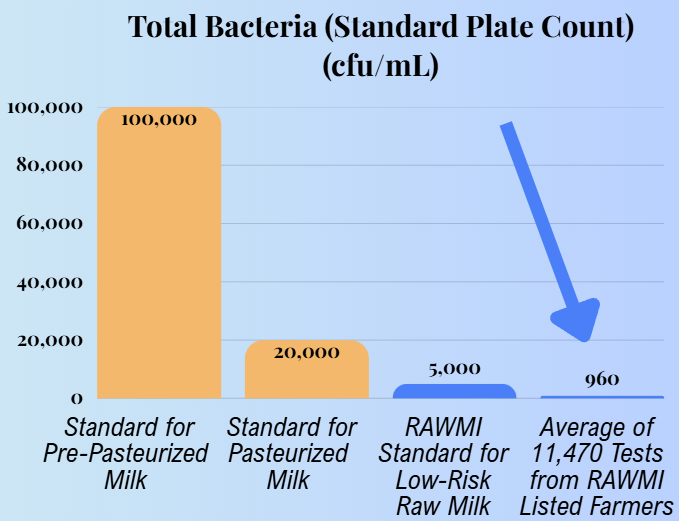
Federal Pasteurized Milk Ordinance (PMO) - Allows up to 100,000 cfu/mL in pre-pasteurized milk.
Federal PMO - Allows up to 20,000 cfu/mL in pasteurized milk.
Raw Milk Institute Common Standards - Allows up to 5,000 cfu/mL in raw milk for direct human consumption.
Coliforms
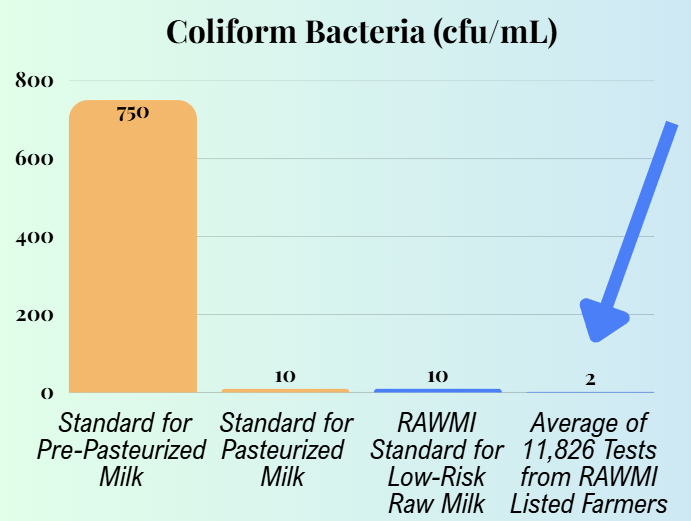
Federal PMO - Allows unlimited number of coliforms in pre-pasteurized milk.
State of California - Allows up to 750 cfu/mL coliforms in pre-pasteurized milk.
Federal PMO - Allows up to 10 cfu/mL in pasteurized milk.
Raw Milk Institute Common Standards - Allows up to 10 cfu/mL in raw milk for direct human consumption.
RAWMI Listed Farmers Are Surpassing Pasteurized Milk Standards
Intentionally-produced raw milk is measurably quite different from pre-pasteurized raw milk and even meets stricter standards than pasteurized milk. Our large dataset of thousands of test results shows that raw milk farmers who have been properly trained can routinely meet the stringent standards set forth in the RAWMI Common Standards.
In analyzing all of the test data from RAWMI Listed farmers over the last 14 years, we found the following for raw milk that was to be used for direct human consumption.
Coliforms
11,826 total tests
Average of all tests = 2.1 cfu/mL
Standard Plate Count
11,470 total tests
Average of all tests = 960 cfu/mL
In over 11,000+ tests, RAWMI Listed Farmers averaged <1,000 cfu/mL for SPC and 2 cfu/mL for coliforms.
Making Low-Risk Raw Milk a Reality Across the USA, Canada, and Beyond!
There are now RAWMI Listed Farmers in 21 states of the USA, 2 Canadian Provinces, and Lebanon. You can check out their Risk Analysis Management Plans and monthly test data here.